Source Modern Folding Telescopic Ladder for Home, Work, and Storage
Explore 29 options for the modern folding telescopic ladder, featuring alloy and steel builds with EN131-6 certification. Compare models like L7 and TLS series, noting weights from 13.4kg to 18.8kg and heights up to 3.8m. Evaluate customization, warranty, and deployment speed for industrial or domestic needs.
Key considerations
Products List


Comprehensive Sourcing Guide
Modern Folding Telescopic Ladder Sourcing Guide
Buyers evaluating modern folding telescopic ladders must first distinguish between telescopic and folding mechanisms, as the supplied data indicates products serving both functions. The observed listings feature alloy and aluminum construction with specific models like the L7 and TLT19040B, suggesting a market segment focused on compact storage and rapid deployment. Procurement teams should verify whether the specific unit requires a telescopic extension for height or a folding A-frame configuration for stability, as the product attributes list both "Telescopic Ladder" and "Folding Ladder" as distinct functional categories.
Commercial listings reveal a wide price variance from 6 to 20,000 USD, which likely reflects differences in material grade, load capacity, and certification levels rather than simple model variations. While some units are described as having a 150kg loading capacity and stainless steel connecting pins, others list steel construction or different step distances. Sourcing strategies must account for this diversity by defining precise technical requirements early, ensuring that the selected supplier provides a unit matching the intended application, whether for domestic use or professional tasks requiring specific height extensions.
Product Scope and Observed Listing Signals
The observed product range includes specific models such as the TLS38040B and TLS32040B, which offer varying straight heights up to 3.8 meters and fold heights around 89 to 95 centimeters. These dimensions are critical for buyers assessing storage constraints in vehicles or small workshops, as the compact folded size allows for efficient transport. The listings also indicate a step distance of approximately 29 centimeters for folding variants, which impacts user comfort and safety during ascent, requiring verification against ergonomic standards for the specific intended user demographic.
Material composition is a primary signal in these listings, with observations noting both aluminum and alloy constructions alongside steel options. The aluminum variants are highlighted for their lightweight nature, with weights ranging from 13.4 kg to 18.8 kg depending on the extended length, making them suitable for frequent repositioning. Buyers must confirm the exact material specification for their order, as steel models may offer different durability characteristics but at a significant weight penalty, potentially affecting portability and ease of handling in tight indoor or outdoor environments.
Technical Specifications to Verify
Procurement teams must rigorously verify the step distance and thickness specifications, as the data shows variations such as 1.5mm and 1.3mm thicknesses and differing step distances between models. These physical attributes directly influence the structural integrity and load-bearing capacity of the ladder, particularly when the unit is fully extended. Buyers should request detailed engineering drawings or test reports confirming that the step spacing and rail thickness meet the specific safety requirements for the intended load, ensuring that the 150kg capacity claim is supported by the actual material dimensions provided.
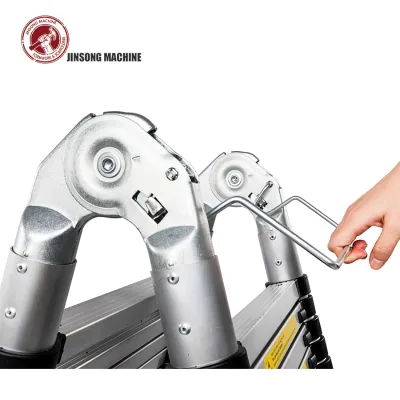
The deployment mechanism and locking systems require close inspection, as the listings mention features like "Fast Deploy" capabilities in 5 seconds and soft-slowing close functions. These mechanical attributes are essential for preventing pinch injuries and ensuring smooth operation during repeated use. Buyers should verify the material of the connecting pins, noting the observation of stainless steel bolts, and confirm that the locking pins engage securely to prevent accidental collapse. Additionally, the insulation status is explicitly listed as non-insulated, a critical safety factor for any work involving electrical hazards that must be clearly understood before deployment.
Compliance and Safety Documentation
Safety compliance is a non-negotiable aspect of sourcing, with the observed data citing the EN131-6 standard for specific models. Buyers must ensure that the supplier provides valid certification documents proving the ladder meets this European standard, which governs safety requirements for ladders. It is vital to distinguish between general EN131 references and the specific EN131-6 designation, as the latter may indicate compliance with newer safety protocols regarding stability and load testing. Without verified documentation, the risk of liability in the event of an accident increases significantly for the end-user.
Beyond certification, the warranty and after-sales service terms provide a secondary layer of safety assurance for the procurement team. The listings indicate warranty periods ranging from 2 to 5 years, which suggests varying levels of manufacturer confidence in product longevity. Buyers should scrutinize the terms of these warranties to understand what constitutes a defect versus normal wear and tear, and verify the availability of replacement parts such as steps or locking mechanisms. A robust after-sales service agreement ensures that any safety-related issues can be addressed promptly, maintaining the operational integrity of the equipment over its lifecycle.
Cost Drivers and Commercial Terms
The observed price range of 6 to 20,000 USD indicates that cost is driven by factors beyond simple material usage, including certification status, packaging standards, and customization options. High-end models with specific certifications like EN131-6 and custom logos likely command premium pricing, while basic domestic units may fall at the lower end of the spectrum. Buyers should analyze the cost structure to understand if the price difference reflects genuine quality improvements or merely branding and packaging enhancements, ensuring that the budget aligns with the necessary safety and performance requirements.
Minimum Order Quantities (MOQ) and lead times are significant commercial variables, with observed MOQs ranging from 1 to 1000 units. This flexibility allows buyers to test the market with small orders or secure bulk pricing for large-scale deployments. However, the wide MOQ range suggests that suppliers may have different production capacities or inventory strategies. Procurement teams must negotiate clear terms regarding lead times and production schedules, especially when ordering customized features like specific colors or logos, to avoid delays that could impact project timelines or operational readiness.
Supplier Qualification and Quality Control
Supplier qualification should focus on the origin and production standards, as the data points to manufacturers located in Beijing and Zhengjiang, China. Buyers must verify the specific factory capabilities to ensure they can consistently produce units meeting the observed specifications, such as the 150kg load capacity and specific step distances. It is essential to confirm that the supplier has a robust quality control process in place to maintain consistency across batches, particularly for critical components like the stainless steel connecting pins and the aluminum alloy rails.
Quality control protocols must also address the packaging and shipping standards, as the listings mention export-standard packing and strong cartons with color and warning labels. Proper packaging is crucial for preventing damage during transit, which could compromise the structural integrity of the ladder before it even reaches the end-user. Buyers should require evidence of packaging testing and ensure that the supplier adheres to international shipping standards to minimize the risk of receiving damaged goods. Additionally, verifying the supplier's ability to provide detailed product manuals and safety warnings is essential for end-user compliance.
Long-Term Procurement Checks
Long-term procurement success depends on monitoring the durability and performance of the ladders over time, particularly regarding the folding and telescopic mechanisms. Buyers should establish a feedback loop with end-users to track any issues with the soft-slowing close functions or the locking pins, as these are common points of failure in telescopic systems. Regular inspections of the step distance and rail thickness can help identify wear patterns early, allowing for proactive maintenance or replacement before a safety incident occurs.
Sustainability and supply chain resilience are also critical considerations for long-term contracts. Buyers should assess the supplier's ability to maintain consistent material quality, especially for aluminum and alloy components, amidst fluctuating market conditions. Ensuring that the supplier can meet future demand without compromising on the EN131-6 certification or other safety standards is vital for maintaining operational continuity. Establishing a partnership based on transparent communication and shared quality goals will help mitigate risks and ensure a reliable supply of high-performance ladders for years to come.
FAQs
What are the available sizes for the telescopic ladder?
The telescopic ladder is available in three specific sizes: 3m, 3.6m, and 4.2m. These dimensions allow users to select the appropriate height for various indoor or outdoor tasks. The straight height reaches up to 3.8m, while the A-type height provides 1.9m plus 1.9m. This variety ensures flexibility for different workspace requirements.
How much does the ladder weigh in different configurations?
The weight varies by size, with the 3m model weighing 13.4kgs, the 3.6m model at 16.1kgs, and the 4.2m model at 18.8kgs. These weights are achieved using aluminum alloy construction. The lightweight design facilitates easy transport and deployment, making it suitable for frequent use in domestic or professional settings without causing fatigue.
Can the ladder be customized with a specific logo?
Yes, customization is available for the ladder, including the option for a customized logo. Buyers can also request specific colors, such as black or white, to match their branding needs. This service allows businesses to brand their equipment effectively. The customization process ensures that the final product meets specific corporate identity requirements while maintaining structural integrity.
What certification does the ladder meet for safety standards?
The ladder meets the En131-6 certification standard, ensuring compliance with rigorous safety requirements. This certification verifies that the product undergoes necessary testing for stability and load-bearing capacity. The loading capacity is rated at 150kg, providing a safe working environment. Adhering to this standard helps buyers ensure workplace safety and regulatory compliance for their operations.
How quickly can the telescopic ladder be deployed?
The ladder features a fast deployment mechanism that takes only 5 seconds to set up. This efficiency is achieved through its telescopic design, which allows for rapid extension and retraction. The quick setup time enhances productivity in urgent situations. Users can easily adjust the height and secure the ladder, making it ideal for tasks requiring immediate access to elevated areas.
What is the fold height when the ladder is stored?
The fold height is approximately 95cm for the 3m model and 89cm for the 13-step variant. These compact dimensions facilitate easy storage in vehicles or small spaces. The ladder packs into a strong carton or export standard packaging for protection. This feature ensures that the ladder remains portable and convenient for users who need to transport it frequently.